
Guide · Money
Money in Thailand: ATM fees, cards, cash and the tourist VAT refund
Thai bank ATMs charge foreign cards 250 THB per withdrawal for Visa, UnionPay and JCB and 350 THB for Mastercard, on top of your own bank's fees, so withdraw larger amounts less often and decline the machine's currency conversion. Tourists can reclaim VAT on purchases of at least 2,000 THB per shop per day if they leave by air within 60 days.
Updated · Checked against official sources
How much do Thai ATMs charge foreign cards?
250 THB per withdrawal for Visa, UnionPay and JCB cards, and 350 THB for Mastercard, according to the official fee schedules of Siam Commercial Bank (SCB, effective 1 September 2026) and Krungsri (effective 11 March 2026). Mastercard's fee rose in 2026: Krungsri's July 2025 schedule still charged 250 THB for it.
| Card network | Fee per withdrawal | Since |
|---|---|---|
| Visa | 250 THB | Unchanged in 2026 |
| UnionPay | 250 THB | Unchanged in 2026 |
| JCB | 250 THB | Unchanged in 2026 |
| Mastercard | 350 THB | 11 Mar 2026 (Krungsri); in SCB's 1 Sep 2026 schedule |
Other large Thai banks are reported to charge similar amounts, but we only checked SCB and Krungsri documents. We have also seen reports of lower fees at some non-bank ATMs and could not confirm them. Whatever the machine charges, your own bank's foreign-transaction and ATM fees come on top.
How do I keep ATM costs down?
- Withdraw fewer, larger amounts: the Thai fee is per withdrawal, not a percentage.
- Check the maximum your card and the machine allow before you travel.
- Use ATMs inside banks or malls, in daylight, and cover the keypad.
- Carry a second card from a different network in case one is blocked or swallowed.
- Tell your bank you are traveling if it blocks unusual foreign activity.
Should I accept the conversion to my home currency?
No. When an ATM or card terminal offers to charge you in your home currency instead of baht, that is dynamic currency conversion (DCC), and the rate is set by the machine's operator rather than your card network. Choose to be charged in THB and let your own bank convert. If a shop has already processed the payment in your currency, you can ask it to cancel and run it again in baht.
Where should I exchange money in Thailand?
At a bank branch, a bank's exchange booth or an authorized money changer. In Thailand, buying and selling foreign currency is limited to businesses holding a foreign-exchange licence from the Minister of Finance, with applications handled by the Bank of Thailand. Street exchangers are outside that system, and you have no recourse if the count comes up short.
- At the airport: bank booths are convenient for a first amount; rates in town are often better, so change only what you need to get started.
- In town: compare the posted buy rate for your currency at two or three booths; many post the rate for large and small notes separately.
- At the counter: bring your passport, count the baht before you leave the window, and keep the receipt.
- Notes: bring clean, undamaged banknotes; torn or marked notes may be refused or bought at a lower rate.
Can I pay by card or contactless in Thailand?
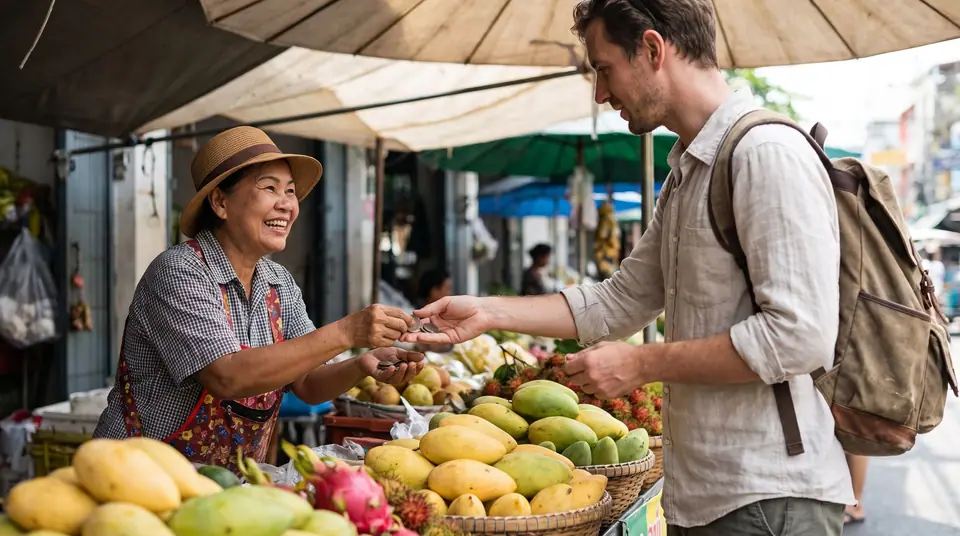
In hotels, malls, supermarkets, chain restaurants and larger shops, yes. At markets, street stalls, small guesthouses and in most meter taxis, expect to pay cash. Public transport is moving to contactless bank cards:
- Airport Rail Link (Suvarnabhumi to the city): tap a contactless Visa, Mastercard or debit card at the gates since 8 November 2025.
- SRT Red Line and MRT Purple Line: paying by contactless (EMV) card caps fares at 40 THB a day from 1 December 2025 to 30 November 2026.
- Common fare plan: the Cabinet approved a Bangkok-wide rail fare of 17–45 THB per journey on 23 June 2026, targeting 1 January 2027. It is not in force yet, and reports do not say whether the Airport Rail Link is included.
How do I pay for taxis and airport transfers?
Meter taxis and tuk-tuks expect cash in baht, and small notes help: drivers often cannot change a 1,000 THB note. You also pay expressway tolls and the 50 THB airport surcharge in cash. Ride-hailing apps show the price before you book and can charge a registered card.
Pre-booked transfers vary, so read the payment terms before you confirm. The Smile Taxi Service network, for example, charges nothing when you book: you pay the driver in cash (THB) at the end of the ride, and if you have not changed money yet you can ask on WhatsApp or LINE for a PayPal card link, with 5% added. Prices are per vehicle, one way, tolls included. Our taxi and transfer guide explains what else to check.
Transparency: Smile Taxi Service and its regional transfer sites are affiliated with Approved Thailand. What we say about them comes from the operator's published terms.
Do you tip in Thailand?
Tipping is appreciated but not expected in the way it is in North America. Nobody will chase you for a tip, and there is no fixed percentage.
- Restaurants: check the bill first. Hotels and many sit-down restaurants add a service charge and 7% VAT; if they do, an extra tip is optional. At street stalls, no tip is expected.
- Meter taxis: rounding up to the next convenient amount is common and welcome.
- Hotel staff, guides and drivers on day trips: a tip in cash at the end is a common way to say thank you for good service.
- Massage and spa: a tip for the therapist is customary in many places; it goes to the person, so hand it over directly.
How does the VAT refund for tourists work?
Visitors who are not Thai and do not live in Thailand can reclaim VAT on goods bought at shops displaying the "VAT Refund for Tourists" sign, if they spend at least 2,000 THB (VAT included) in one shop on one day and take the goods out of Thailand by air, from an international airport, within 60 days. Airline crew departing on duty are excluded.
- On the day of purchase, show your passport and ask for form P.P.10 (or the electronic e-P.P.10) and the original tax invoices.
- At the departure airport, before check-in, show the goods to Customs if your total purchases are 20,000 THB or more.
- After passport control, show luxury items again at the VAT Refund office: items worth 40,000 THB or more each, or carry-on items worth 100,000 THB or more.
- Collect the refund at the VAT Refund office. e-P.P.10 claims can also be made at airport kiosks.
| Rule | Threshold or detail |
|---|---|
| Minimum purchase | 2,000 THB including VAT, per shop, per day |
| Deadline | Goods leave Thailand by air within 60 days of purchase |
| Customs inspection before check-in | Total purchases of 20,000 THB or more |
| Refund up to 30,000 THB | Cash in baht, credit card, Alipay or WeChat |
| Refund over 30,000 THB | Bank draft or credit card, minus bank and postage fees |
| Downtown refund (Bangkok airport departures) | Up to 12,000 THB in cash; the goods must leave the country within 14 days |
| Refund amount | A sliding scale: for example 80 THB on 2,000–2,499 THB of purchases, rising to 6.1% at 200,000 THB or more |
Refunds are paid at airport VAT Refund offices at Suvarnabhumi, Don Mueang, Chiang Mai, Phuket, Hat Yai, U-Tapao, Krabi, Samui, Surat Thani, Chiang Rai and Udon Thani. The VAT rate stays at 7% until 30 September 2027 after a Cabinet decision in July 2026. Some guides still mention a 5,000 THB minimum total; the current official conditions list only the 2,000 THB per shop per day rule.
How much cash can I carry into or out of Thailand?
You can bring in any amount, but you must declare it to customs if you carry more than 450,000 THB in Thai banknotes or more than USD 15,000 equivalent in foreign banknotes, arriving or leaving. The USD 20,000 threshold still shown on some embassy pages is out of date.
- Thai baht leaving Thailand: up to 50,000 THB without Bank of Thailand permission.
- To Myanmar, Laos, Cambodia, Malaysia, Vietnam or Yunnan (China): up to 2,000,000 THB.
The other documents you need at the border are covered in our Thailand entry requirements guide, and the numbers to call if a card or wallet is stolen are in emergency numbers for Thailand.
The approved way
- Arrive with some baht or withdraw once, a larger amount, at a bank ATM.
- Always choose to be charged in THB.
- Exchange at banks or authorized money changers and keep the receipt.
- Ask for the P.P.10 form on the day you shop if you plan to claim VAT.
Avoid
- Many small ATM withdrawals, each with its own fee.
- Dynamic currency conversion at ATMs and card terminals.
- Street money changers and "special rate" offers.
- Carrying undeclared cash above the customs thresholds.
Frequently asked questions
What is the ATM fee in Thailand for foreign cards in 2026?
250 THB per withdrawal for Visa, UnionPay and JCB, and 350 THB for Mastercard, according to the 2026 fee schedules of SCB and Krungsri. Your own bank may add its own fees on top.
Is it better to exchange money before going to Thailand?
Bring enough baht or a working card for your first day. Rates at authorized money changers in Thai cities are often better than at home or at the airport, so many travelers exchange most of their cash after arrival.
What is the minimum purchase for a VAT refund in Thailand?
2,000 THB including VAT, in one shop on one day, with form P.P.10 issued on the day. There is no separate 5,000 THB total minimum in the current Revenue Department conditions.
Can I get a VAT refund if I leave Thailand by land?
No. The goods must leave Thailand by air from an international airport within 60 days of purchase, and refunds are paid at airport VAT Refund offices or through the downtown refund for Bangkok airport departures.
Do I need to tip taxi drivers in Thailand?
No. Rounding up the meter fare is common and appreciated, but it is not expected. For a pre-booked driver on a long day trip, a cash tip at the end is a common thank-you for good service.
Can I pay for a pre-booked airport transfer by card?
It depends on the operator. With the Smile Taxi Service network you pay the driver in baht at the end, or ask by WhatsApp or LINE for a PayPal card link with a 5% fee; nothing is charged when you book.
Sources
- Card and electronic service fees (Thai PDF, effective 1 Sep 2026) — Siam Commercial Bank, checked 27 Sep 2026
- ATM withdrawal fee for international cards (Thai PDF, effective 11 Mar 2026) — Krungsri, checked 27 Sep 2026
- ATM withdrawal fee for international cards (Thai PDF, effective 1 Jul 2025) — Krungsri, checked 27 Sep 2026
- Authorized money changers — Bank of Thailand, checked 27 Sep 2026
- Exchange control regulation — Bank of Thailand, checked 27 Sep 2026
- Currency regulations (PDF) — Thai Customs Department, checked 27 Sep 2026
- VAT Refund for Tourists: conditions — Revenue Department, checked 27 Sep 2026
- VAT Refund for Tourists: payment methods — Revenue Department, checked 27 Sep 2026
- VAT Refund for Tourists: airports — Revenue Department, checked 27 Sep 2026
- VAT Refund, Suvarnabhumi Airport — Airports of Thailand, checked 27 Sep 2026
- Cabinet approves one-year extension of 7% VAT until September 2027 — The Nation, checked 27 Sep 2026
- Airport Rail Link launches EMV contactless payment — The Nation, 5 Nov 2025, checked 27 Sep 2026
- Bangkok rail fares to be capped at 45 baht under Jan 1 common-ticket plan — The Nation, 15 Aug 2026, checked 27 Sep 2026